New bungalow, Harrow
Supporting new build near a conservation area requires careful consideration and justification. Mark was asked to provide a Heritage Statement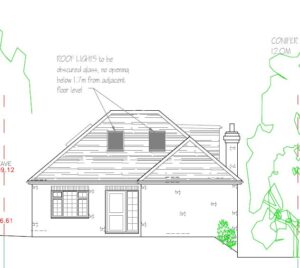 to support a proposal for a new bungalow on a plot of land near the boundary of a conservation area designated by the London Borough of Harrow.
The scheme needed detailed reasoning to ensure the new building preserved the Pinnerwood Park Estate Conservation Area, Pinner. The housing estate was laid out and constructed between 1931-9 by the Artisans, Labourers and General Dwellings Company with 420 houses. The Company was founded by William Austin, a drain laying contractor, in 1867, to meet the demand for housing in London.
Pinnerwood Park Estate Conservation Area is significant as an early example of 20th Century domestic architecture and town planning. The Area sought to provide accommodation the artisans. This was accomplished through low density housing, tree-lined streets and houses separated by soft landscaping. The garden city design led to an attractive grouping of buildings.
A statement of significance and a justification for the proposals was provided taking into account national policy. Mark was able to evidence his view that the new bungalow would not harm views to or from the conservation area. He was also able to show how the development complied with Harrow’s Core Policy Objectives.
Conservation area designation does not exclude all possibility of new build on the boundary, but requires that it preserves or enhances the character or appearance. There were additional policies to consider, as there was an adopted Conservation Area Appraisal and Management Strategy for the estate.
Mark was able to provide a Heritage Statement adhering to national and local guidance.